
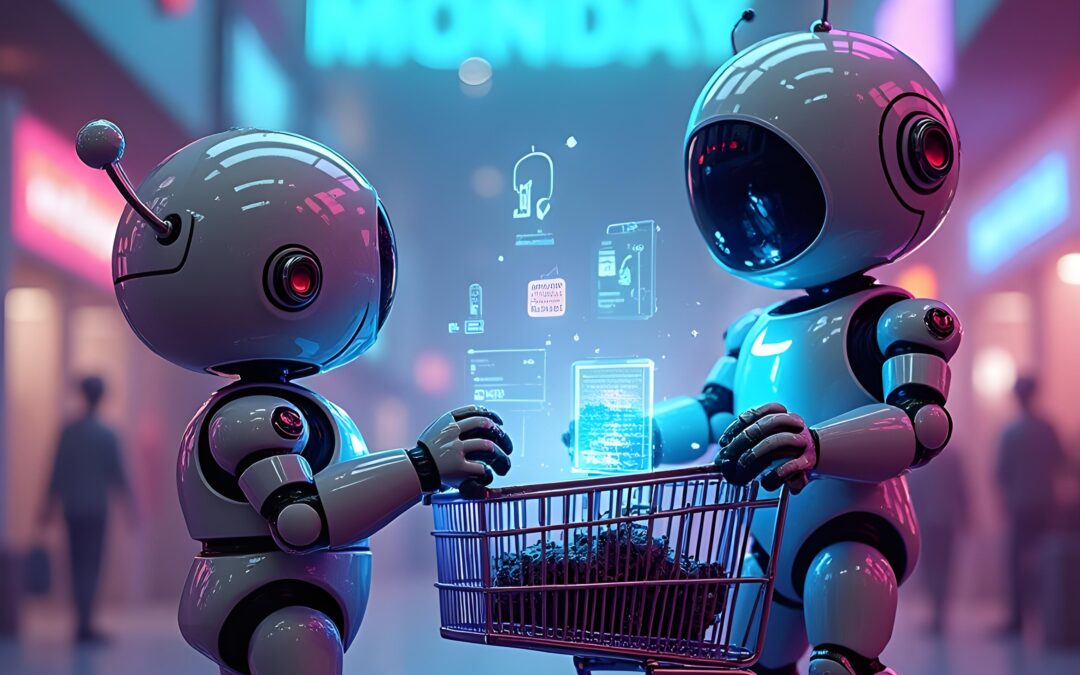
E-commerce is entering a new era — one where operations are not just automated but intelligent. Traditional tools helped sellers scale, but they still required constant human involvement. Today, a new class of technology is emerging: AI agents — autonomous systems capable of thinking, planning, deciding, and executing tasks across the entire e-commerce workflow.
These agents behave like digital employees.
They don’t wait for instructions.
They anticipate problems, propose solutions, and take action.
E-commerce is shifting from:
human-led operations using tools → AI-led operations supervised by humans.
This transformation is redefining how brands launch, scale, and manage their online retail ecosystem.
Why AI Agents Are Becoming Essential in E-Commerce
Running an e-commerce business isn’t simple. A single store must juggle:
- Customer support
- Product listing creation
- Catalog hygiene
- Pricing & competitor analysis
- Inventory & demand forecasting
- Advertising optimization
- Supply chain & delivery
- Returns and refunds
- Reputation management
- Market expansion
The complexity increases as a brand scales across marketplaces, warehouses, and customer segments.
AI agents help by turning overwhelming workflows into autonomous systems that operate 24/7.
They can:
- Read and interpret large datasets
- Predict outcomes
- Execute multi-step tasks
- Communicate with customers
- Manage commerce platforms
- Handle exceptions
- Learn and improve continuously
In other words, AI agents reduce operational load while increasing speed and accuracy.
Where AI Agents Are Creating the Biggest Transformation
Below are the major areas in e-commerce where AI agents are already making measurable impact.
1. Customer Service Automation Beyond Chatbots
E-commerce support teams deal with high ticket volumes — order updates, delivery delays, refund requests, defective product complaints, warranty claims, and more.
AI agents now handle:
- Entire email and chat conversations
- Order status lookups
- Refund processing
- Replacement approvals
- Complaint analysis
- Sentiment tracking
- Escalation to human agents only when needed
Unlike old bots, these systems understand nuance, tone, and customer frustration.
They respond in human-like language, improving CSAT and resolution times.
For many brands, 40–70% of customer service can now be handled end-to-end by AI.
2. Catalog and Listing Management — Fully Automated
A catalog is the backbone of e-commerce success, yet it’s the most time-consuming task.
AI agents can:
- Write optimized product titles
- Generate bullet points and descriptions
- Fix inconsistencies in sizes, dimensions, colors
- Identify missing attributes
- Analyze images for compliance
- Detect duplicate or inaccurate listings
- Ensure content consistency across all marketplaces
This reduces manual errors while improving product visibility and conversions.
3. Dynamic Pricing & Competitor Monitoring
E-commerce pricing is fluid.
Competitors change prices multiple times a day.
Demand shifts unpredictably.
AI agents track:
- Marketplace prices
- Demand spikes
- Historical performance
- Inventory levels
- Profit margins
- Seasonal patterns
Based on this data, they adjust prices in real time to:
- Win the buy box
- Increase conversions
- Maximize revenue
- Balance margins
This was once the job of pricing analysts — now done by AI with near-perfect accuracy.
4. Inventory Forecasting & Supply Chain Planning
Overstock kills cash flow.
Understock kills sales.
AI agents solve this by analyzing:
- Past sales
- Seasonality
- Upcoming campaigns
- Social trends
- Warehouse-level demand
- Returns and cancellations
- Lead times from suppliers
They generate accurate purchase plans and can even:
- Trigger restocking alerts
- Recommend optimal order quantities
- Flag risky SKUs
- Predict dead stock
Supply chains operate faster and more efficiently with fewer errors.
5. Advertising and Marketing Optimization
Ad platforms are complex — dozens of audience segments, bidding rules, creatives, and metrics.
AI agents act like autonomous performance marketers.
They can:
- Launch campaigns
- Generate creatives
- Test different variations
- Adjust budgets
- Pause poor-performing ads
- Scale successful ones
- Monitor ROAS + CAC in real time
- Provide daily marketing insights
This eliminates the need for large marketing teams and dramatically reduces wasted spend.
Beyond Tasks: AI Agents as Decision Makers
The real breakthrough is that AI agents are not limited to execution.
They also plan, prioritize, and strategize.
Examples:
- “Which SKUs are most profitable to promote during sale season?”
- “Which supplier is causing the most delays?”
- “Which returns reason is increasing month over month?”
- “Which marketplaces should we expand into next?”
These insights previously required managers and analysts.
AI agents now deliver them automatically.
The Future: Fully Autonomous E-Commerce
We are moving toward AI systems that can manage:
- End-to-end logistics coordination
- Cross-border marketplace expansion
- Supplier negotiation support
- Influencer outreach & affiliate management
- Customer lifecycle automation
- Personalized storefront experiences
- Fraud detection & chargeback management
The merchant’s role will shift from daily execution to strategy, creativity, product innovation, and oversight.
AI handles the grunt work.
Humans handle the vision.
Final Thoughts: The Rise of Autonomous E-Commerce
AI agents mark a turning point in online retail.
They bring:
- Faster operations
- Fewer errors
- Lower costs
- Higher scalability
- Better customer satisfaction
- More predictable growth
- Streamlined workflows
E-commerce is becoming a system that can run itself — with humans guiding the mission.
Brands that adopt AI agents early will gain a massive competitive edge, operating at a speed and efficiency unreachable through manual teams.