
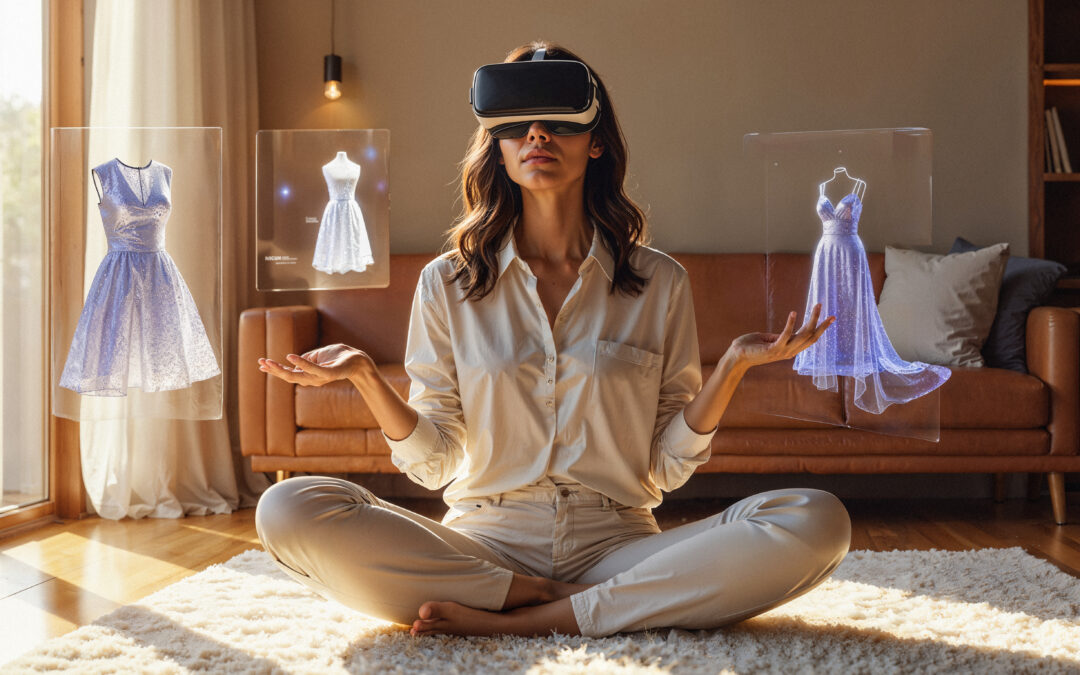
E-commerce has always had one big gap: customers can’t touch, feel, or try the product before buying. Photos, descriptions, and reviews help — but they don’t replace the physical experience. This gap leads to hesitation, abandoned carts, and a massive volume of returns.
AR and virtual try-on technology are completely changing that. What was once a “nice to have” feature for the largest of brands is rapidly becoming a powerful conversion tool for businesses of all sizes. Customers can see how a product fits, looks, or feels in real life-all through their phone camera.
In this blog, let’s explore how AR is changing the face of online shopping, why customers love it, and how brands can start using AR without breaking the bank.
The New Shopping Habit: Try Before You Buy — Digitally
Today’s online shoppers crave confidence. They desire to know precisely what they will get. AR bridges the biggest trust gap by letting customers:
Place furniture in the living room.
Try a watch on their wrist
See how glasses look on their face
Preview wall paint in their home
Testing lipstick or makeup colors on their skin
Instead of guessing, they get a near-real-life preview. This shifts shopping from “I hope it fits” to “I know it fits,” which completely changes how customers behave.
Why AR is Becoming a Must-Have in E-commerce
1. Higher Conversions
When using AR, shoppers feel more sure; that confidence directly raises conversions. Studies confirm repeatedly that try-on experiences increase purchase likelihood because buyers no longer feel they’re taking a risk.
2. Lower Returns
Returns are expensive, especially in categories like fashion, furniture, and cosmetics. Since AR helps customers visualize accurately, they make fewer wrong choices. This reduces reverse logistics, saves cost, and improves profitability.
3. Stronger brand perception
This is because brands offering AR are considered innovative, premium, and customer-centric. Even if shoppers don’t use this feature very often, just seeing it available will gain their trust.
4. More Time Spent on the Site
While customers spend more time browsing, customizing, comparing, and trying options during AR engagement, longer engagement usually leads to higher sales.
How customers use AR across categories
AR is no longer limited to virtual glasses or beauty filters; it’s being adopted in nearly every major product category.
Fashion & Accessories
Virtual try-ons let customers virtually see how clothes, sunglasses, watches, jewelry, and shoes look on them. And every month, body mapping technology is becoming more precise.
Furniture & Home Decor
Shoppers can place sofas, tables, lamps, or art directly in their room. They can rotate items, change colors, and check sizing-something impossible through photos.
Cosmetics & Beauty
AR enables users to try foundation shades, lip colors, eye makeup, and skincare results. Brands like Sephora and Nykaa have already shown just how powerful this can be.
Eyeglasses
This is one of the maturest AR categories. There, people can instantly see how big the frame is, its width, shape, and general look.
Automotive
Some car brands allow shoppers to customize interiors, wheels, colors, and even place the car in their driveway.
Real Estate
Prospective customers can also walk through virtual rooms and check out interiors without visiting the place in person.
AR has evolved from a “cool feature” to a functional shopping tool that solves real problems.
Customer Decision-Making
With AR, shopping doesn’t just become more fun; it gets smarter, too. When customers are able to visualize products:
They compare faster.
They feel more in control.
They believe in the product information.
They avoid uncertainty.
They move from browsing to buying more smoothly.
That kind of emotional comfort is incredibly powerful. The biggest fear for most consumers on line is “What if it doesn’t match what I expected?” AR eliminates that fear.
Why Brands Are Rushing to Adopt AR
Until just a few years ago, AR was expensive and required custom development. Today, it’s much easier:
Shopify, WooCommerce, and Magento all support AR integrations.
Both Instagram and Snapchat offer AR try-on filters.
Several SaaS platforms offer pay-per-use or subscription AR models.
Even the budget phones these days are AR-ready.
That means even small or mid-sized brands can launch AR without massive investments.
Moreover, AR content resonates very well on social media. Users share screenshots or videos of themselves trying out products. This encourages organic discovery and leads to word-of-mouth.
Common Concerns (And Why They’re No Longer Barriers)
“Isn’t AR expensive?”
The costs have dropped massively. Most of the tools charge like any SaaS: monthly or per product.
“Will customers really use it?”
Correct. Even if 20–30% use it, the conversion lift pays for itself.
“Is it complicated to manage?”
Most platforms handle the heavy lifting: brands just need to upload product images or 3D models.
“Does it work on all phones?”
All modern devices support AR via the browser, with no app necessary.
How Brands Can Start Using AR Today
Here’s a simple roadmap:
PINpoint products where customers will always think twice, mainly fashion, beauty, furniture, and décor.
Choose the AR platform depending on your store platform.
Convert key SKUs to AR/3D models. Most tools will do this for you.
Add “Try in your space” or “Virtual Try-On” buttons to product pages.
Promote AR features in advertisements, reels, and banners.
Monitor engagement and identify which products benefit most.
Even with a small rollout on 5–10 flagship products, the results can be impressive.
The Future of Shopping Is Not Just Online — It’s Interactive
In a couple of years, augmented reality will be a standard element of an e-commerce experience, not an optional feature. Along with the advancement in AI-generated 3D models, body scanning, and hyper-personalized virtual try-ons, customers will expect to be able to preview everything before buying. Early-adopter brands stand to benefit from increased trust, reduced returns, and better customer loyalty, while differentiating themselves from their competitors. AR is not just the future of shopping. It’s the future of decision-making.